

Getting a leg up from cell robots comes right down to getting a bunch of legs. Georgia Institute of Expertise
By Baxi Chong (Postdoctoral Fellow, Faculty of Physics, Georgia Institute of Expertise)
Including legs to robots which have minimal consciousness of the atmosphere round them may help the robots function extra successfully in troublesome terrain, my colleagues and I discovered.
We have been impressed by mathematician and engineer Claude Shannon’s communication concept about easy methods to transmit indicators over distance. As an alternative of spending an enormous sum of money to construct the right wire, Shannon illustrated that it’s adequate to make use of redundancy to reliably convey info over noisy communication channels. We questioned if we may do the identical factor for transporting cargo through robots. That’s, if we wish to transport cargo over “noisy” terrain, say fallen timber and huge rocks, in an inexpensive period of time, may we do it by simply including legs to the robotic carrying the cargo and achieve this with out sensors and cameras on the robotic?
Most cell robots use inertial sensors to realize an consciousness of how they’re shifting by house. Our key thought is to overlook about inertia and substitute it with the easy perform of repeatedly making steps. In doing so, our theoretical evaluation confirms our speculation of dependable and predictable robotic locomotion – and therefore cargo transport – with out further sensing and management.
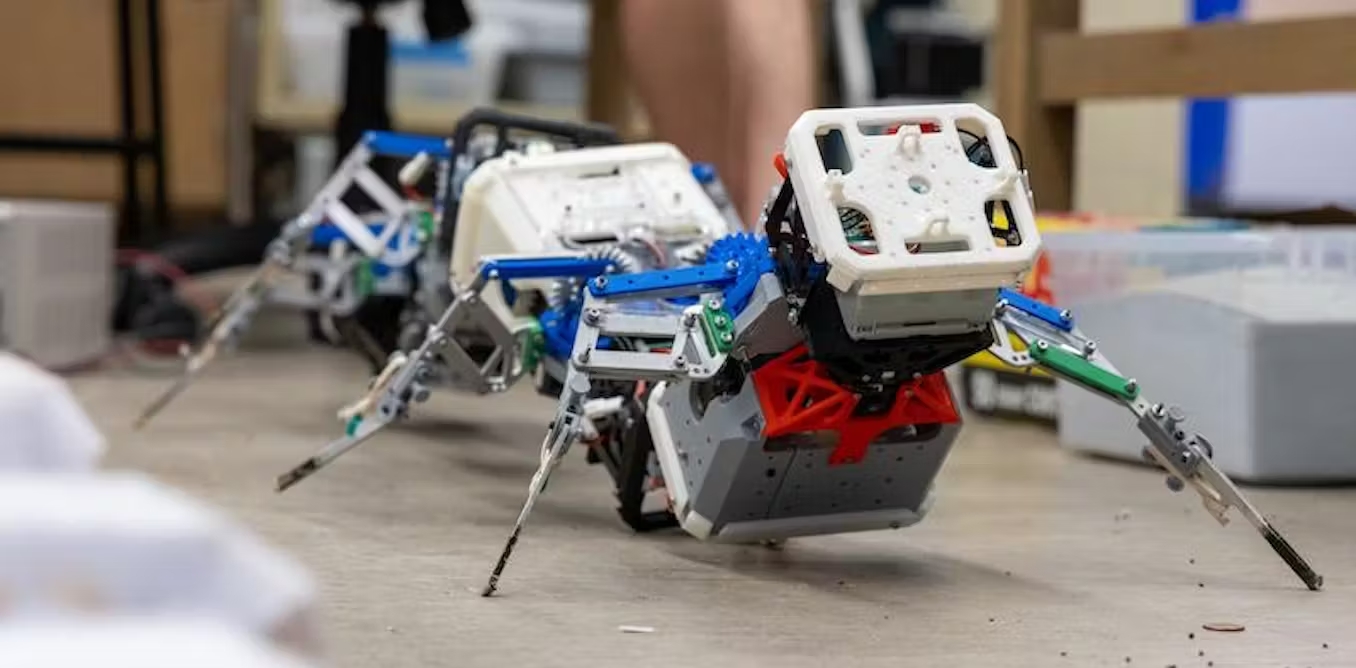
To confirm our speculation, we constructed robots impressed by centipedes. We found that the extra legs we added, the higher the robotic may transfer throughout uneven surfaces with none further sensing or management know-how. Particularly, we carried out a collection of experiments the place we constructed terrain to imitate an inconsistent pure atmosphere. We evaluated the robotic locomotion efficiency by regularly rising the variety of legs in increments of two, starting with six legs and finally reaching a complete of 16 legs.
Navigating tough terrain might be so simple as taking it a step at a time, not less than when you’ve got a variety of legs.
Because the variety of legs elevated, we noticed that the robotic exhibited enhanced agility in traversing the terrain, even within the absence of sensors. To additional assess its capabilities, we carried out out of doors exams on actual terrain to judge its efficiency in additional lifelike situations, the place it carried out simply as effectively. There may be potential to make use of many-legged robots for agriculture, house exploration and search and rescue.
Why it issues
Transporting issues – meals, gas, constructing supplies, medical provides – is crucial to fashionable societies, and efficient items change is the cornerstone of business exercise. For hundreds of years, transporting materials on land has required constructing roads and tracks. Nevertheless, roads and tracks are usually not out there in every single place. Locations resembling hilly countryside have had restricted entry to cargo. Robots is perhaps a method to transport payloads in these areas.
What different analysis is being accomplished on this area
Different researchers have been growing humanoid robots and robotic canine, which have change into more and more agile lately. These robots depend on correct sensors to know the place they’re and what’s in entrance of them, after which make selections on easy methods to navigate.
Nevertheless, their robust dependence on environmental consciousness limits them in unpredictable environments. For instance, in search-and-rescue duties, sensors might be broken and environments can change.
What’s subsequent
My colleagues and I’ve taken precious insights from our analysis and utilized them to the sector of crop farming. We’ve based an organization that makes use of these robots to effectively weed farmland. As we proceed to advance this know-how, we’re targeted on refining the robotic’s design and performance.
Whereas we perceive the useful points of the centipede robotic framework, our ongoing efforts are geared toward figuring out the optimum variety of legs required for movement with out counting on exterior sensing. Our aim is to strike a stability between cost-effectiveness and retaining the advantages of the system. At the moment, we have now proven that 12 is the minimal variety of legs for these robots to be efficient, however we’re nonetheless investigating the perfect quantity.
The Analysis Transient is a brief tackle attention-grabbing educational work.

The authors has acquired funding from NSF-Simons Southeast Heart for Arithmetic and Biology (Simons Basis SFARI 594594), Georgia Analysis Alliance (GRA.VL22.B12), Military Analysis Workplace (ARO) MURI program, Military Analysis Workplace Grant W911NF-11-1-0514 and a Dunn Household Professorship.
The creator and his colleagues have a number of pending patent purposes associated to the analysis lined on this article.
The creator and his colleagues have established a start-up firm, Floor Management Robotics, Inc., partially primarily based on this work.
This text is republished from The Dialog underneath a Inventive Commons license. Learn the unique article.

The Dialog
is an unbiased supply of reports and views, sourced from the tutorial and analysis group and delivered direct to the general public.
The Dialog
is an unbiased supply of reports and views, sourced from the tutorial and analysis group and delivered direct to the general public.

