


This weblog was written by Annika Mammen, former Person Expertise Engineer at Cisco
There are such a lot of areas to contemplate when coping with defending and detecting threats, sadly cognitive overload is one drawback that’s usually ignored. Bear in mind when search engines like google had one million information articles, studying ideas, and market evaluation on the house web page. Customers needed to sift via the mountain of knowledge and resolve what was the perfect supply for them. It is a prime instance of cognitive overload, and that is one thing most SOC analysts know too properly. Too many choices and sophisticated steps make customers really feel pissed off and confused. Their mind is being given an excessive amount of info to course of and will get overwhelmed. When Google got here on the scene with a single search bar, customers flocked to it as a result of it modified the sport. It helped arrange information and surfaced up probably the most related items of knowledge. The one search bar on the web page made it very straightforward for customers to grasp what they needed to do. A clear outcomes web page made it abundantly clear which hyperlinks had been most vital. Lastly, only a few outstanding buttons on the web page made it straightforward to know what the following step was.
The identical ideas and issues seem within the safety area, irritating SOC analysts and making their jobs a lot tougher. They take care of having an excessive amount of info, too many selections and no actual option to arrange the info to assist customers make higher data-driven choices. To have the perfect consumer expertise attainable, designers leverage a way referred to as progressive disclosure. It’s a sample used to interrupt down the data into chunk sized items and feed it to the consumer as and when wanted. A great instance of this in on a regular basis life is the typical ATM. The primary display screen simply exhibits just a few choices like withdraw, deposit, and examine account balances. Inside seconds, you perceive what motion you will need to take to deposit your cash. When you select an possibility, it takes you to the following chunk sized step. Straightforward!
Equally, the safety world is full of alerts, metrics, targets, and many others. It’s straightforward to fall into the cognitive overload entice. Cisco XDR makes use of progressive disclosure to assist cut back that cognitive load, assist novice and skilled customers, and assist customers to concentrate on excessive precedence incidents and remediate rapidly. Now, allow us to have a look at how we obtain that.
1. Danger Rating
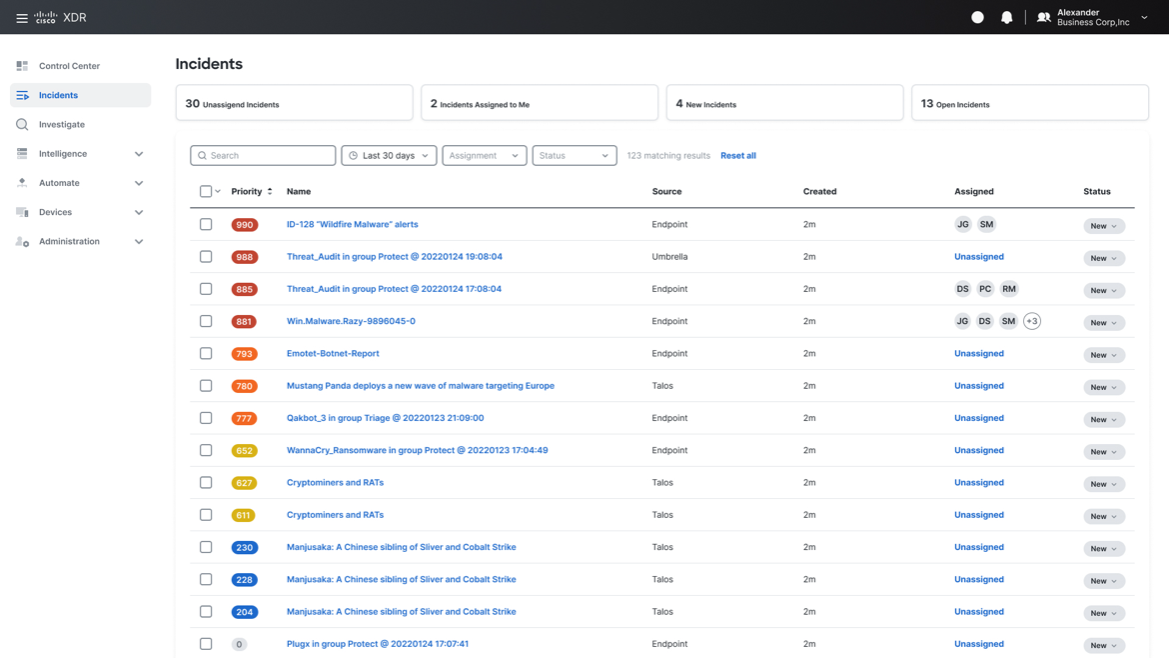
Incidents are ranked based mostly on a color-coded danger rating. Instantly the consumer’s focus is drawn to the excessive precedence incidents which are marked with a purple coded rating. Novice customers who aren’t accustomed to the scoring methodology can hover over the rating and see a popup with a proof.
2. View Incident Particulars
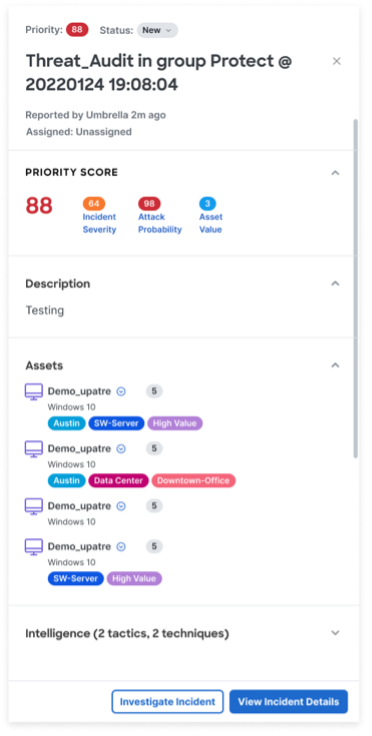
As soon as an incident is chosen, a drawer opens on the facet. This supplies a high-level overview of the incident. In a single look the consumer can see the incident standing, assignees, description, breakdown of danger rating, and property. The consumer can assess if this incident should be prioritized with out having to depart the web page. For additional particulars, they’ll click on on ‘View Incident Particulars’ to load an in depth web page of the incidents.
3. Management Heart Tiles
The tiles displayed on the management heart give a high-level overview of key metrics to raised perceive the well being of the system with out being too granular on the main points. A consumer can create new dashboards or edit present ones. This additionally helps the consumer see patterns and concentrate on areas that should be prioritized.

4. Navigation Menu
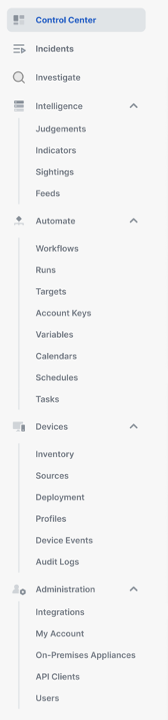
Usually, the overwhelming quantity of knowledge and actions that may be taken are unfold throughout quite a few screens. It may be straightforward for analysts to get misplaced within the maze. With Cisco XDR, we’ve got grouped actions into 7 important classes, that are additional damaged down into 26 subcategories. We progressively take the consumer deeper into the product to get them to the place they wish to go.
5. Examine Node Map
Mapping out an incident can typically seem like a map of the Labyrinth. Information, property, and IP addresses, to call just a few, linked with quite a few strains could be exhausting to decipher. Traditional cognitive overload drawback. XDR has grouped these so solely key nodes are displayed within the map. On hover, every key node will increase to indicate extra nodes and the strains connecting them will show extra info on the connection between every node. Clicking on a node will carry up a popup that shows choices for additional investigation.
Cisco XDR was constructed by SOC practitioners, for SOC practitioners, and lays out info in a constant and simple to observe format – first a abstract view of the info, then customers can drill right down to an in depth view of that very same information, and eventually if needed (or out of pure curiosity and curiosity!) customers can drill down once more to see the uncooked information view. Utilizing progressive disclosure and this constant show of knowledge, Cisco XDR helps SOC analysts view the data they should transfer ahead and take subsequent steps to successfully mitigate threats. No extra evaluation paralysis, solely data-based choices right here!
We’d love to listen to what you suppose. Ask a Query, Remark Under, and Keep Linked with Cisco Safe on social!
Cisco Safe Social Channels
Share:

