

The Nationwide Archives / Renaud Morieux
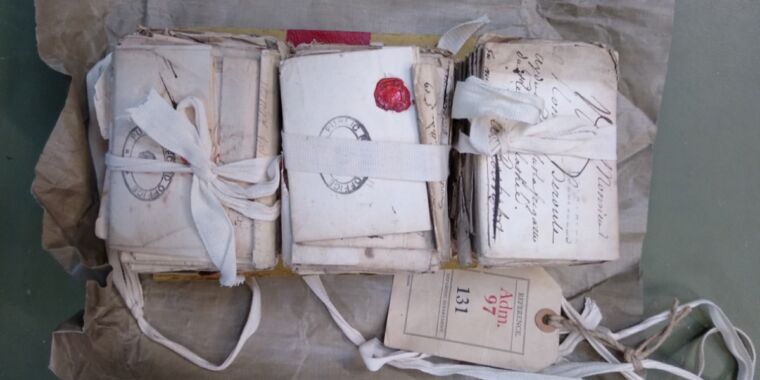
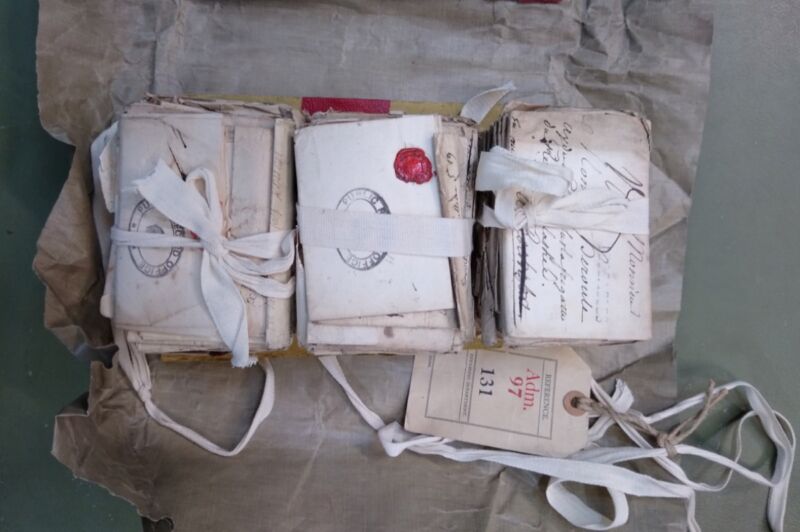
College of Cambridge historian Renaud Morieux was poring over supplies on the Nationwide Archives in Kew when he got here throughout a field holding three piles of sealed letters held collectively by ribbons. The archivist gave him permission to open the letters, all addressed to 18th century French sailors from their family members and seized by Nice Britain’s Royal Navy through the Seven Years’ Conflict (1756-1763).
“I noticed I used to be the primary individual to learn these very private messages since they’re written,” mentioned Morieux, who simply revealed his evaluation of the letters within the journal Annales Histoire Sciences Sociales. “These letters are about common human experiences, they’re not distinctive to France or the 18th century. They reveal how all of us address main life challenges. Once we are separated from family members by occasions past our management just like the pandemic or wars, now we have to work out the way to keep in contact, the way to reassure, take care of individuals and maintain the eagerness alive. Right now now we have Zoom and WhatsApp. Within the 18th century, individuals solely had letters, however what they wrote about feels very acquainted.”
England and France have a protracted, sophisticated historical past of being at battle, most notably the Hundred Years’ Conflict within the 14th and fifteenth centuries. The 2 international locations had been additionally virtually repeatedly at battle through the 18th century, together with the Seven Years’ Conflict, which was fought in Europe, the Americas, and Asia-Pacific as England and France tried to ascertain world dominance with assistance from their respective allies. The battle technically advanced out of the North American colonies when England tried to develop into territory the French had already claimed. (Enjoyable reality: A 22-year-old George Washington led a 1754 ambush on a French power on the Battle of Jumonville Glen.) However the battle quickly unfold past colonial borders, and the British went on to grab tons of of French ships at sea.

The Nationwide Archives / Renaud Morieux
In keeping with Morieux, regardless of its assortment of fantastic ships throughout this era, France was quick on skilled sailors, and the massive numbers imprisoned by the British—almost a 3rd of all French sailors in 1758—did not assist issues. Many sailors finally returned house, though a couple of died throughout their imprisonment, normally from malnutrition or sickness. It was no straightforward feat delivering correspondence from France to a consistently transferring ship; usually a number of copies had been despatched to totally different ports in hopes of accelerating the percentages of a letter reaching its supposed recipient.
This explicit batch of letters was addressed to varied crew members of a French warship known as the Galitee, which was captured by a British ship known as the Essex en route from Bordeaux to Quebec in 1758. Morieux’s genealogical analysis accounted for each member of the crew. Naturally, a few of the missives had been love letters from wives to their husbands, such because the one Marie Dubosc wrote to her husband, a ship’s lieutenant named Louis Chambrelan, in 1758, professing herself his “without end trustworthy spouse.” Morieux’s analysis confirmed that Marie died the next 12 months earlier than her husband was launched; Chambrelan remarried when he returned to France, having by no means obtained his late spouse’s missive.
Morieux learn a number of letters addressed to a younger sailor from Normandy named Nicolas Quesnel, from each his 61-year-old mom, Marguerite, and his fiancée, Marianne. Marguerite’s letters chided the younger man for writing extra usually to Marianne and to not her, laying the guilt thick. “I feel extra about you than you about me,” the mom wrote (or extra doubtless, dictated to a trusted scribe), including, “I feel I’m for the tomb, I’ve been sick for 3 weeks.” (Translation: “Why do not you write to your poor sick mom earlier than I die?”)

The Nationwide Archives / Renaud Morieux
Apparently, Quesnel’s neglect of his mom prompted some pressure with the fiancée since Marianne wrote three weeks later asking him to please write to his mother and take away the “black cloud” within the family. However then Marguerite merely complained that Quesnel made no point out of his stepfather in his letters house, so the poor younger man actually could not win. Quesnel survived his imprisonment, per Morieux, and ended up engaged on a transatlantic slave ship.
For Morieux, studying the letters shed new mild on the lives of shipmen and their households, significantly the ladies. “These letters present individuals coping with challenges collectively,” he mentioned. “Right now we’d discover it very uncomfortable to write down a letter to a fiancée realizing that moms, sisters, uncles, neighbors would learn it earlier than it was despatched, and lots of others would learn it upon receipt. It’s laborious to inform somebody what you actually take into consideration them with individuals peering over your shoulder. There was far much less of a divide between intimate and collective.”
Annales Histoire Sciences Sociales, 2023. DOI: 10.1017/ahss.2023.75 (About DOIs). (In French)


