


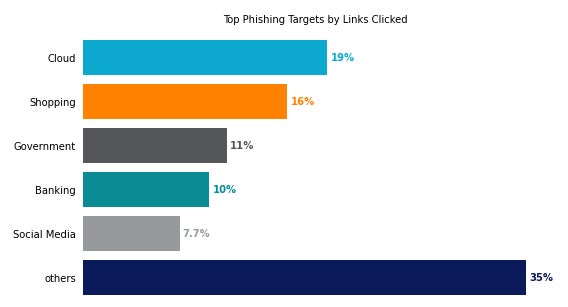
A brand new report from Netskope detailing the highest strategies utilized by cybercriminals to assault organizations discovered that cloud apps are more and more being utilized by risk actors, representing 19% of all clicks on spearphishing hyperlinks. The report additionally make clear the attackers’ targets in line with their monetary or geopolitical motivations.
This Cloud and Risk report from Netskope, which is a U.S.-based firm specializing in Safe Entry Service Edge, mirrored the primary three quarters of 2023.
Bounce to:
Prime strategies utilized by cyberattackers
The commonest ways and strategies deployed by attackers to compromise methods, execute malicious code and talk with the contaminated system are cut up into 4 classes by Netskope: preliminary entry, malicious payloads execution, command and management and exfiltration.
Preliminary entry
The simplest means for an attacker to entry a focused system is by way of its customers; that is very true if the focused group has patched all methods speaking with the web and is subsequently not topic to widespread vulnerabilities exploitation. Social engineering is the most well-liked technique utilized by attackers to focus on organizations, whether or not it’s by electronic mail (spearphishing), voice (vishing), SMS (smishing) or by way of social networks.
Netskope analyzed the phishing hyperlinks customers clicked on and concluded that customers most steadily clicked on phishing hyperlinks associated to cloud apps (19%), adopted by e-commerce web sites (16%) similar to Amazon, eBay or much less widespread purchasing websites (Determine A).
Determine A
In keeping with Netskope, one third of the phishing operations concentrating on cloud apps centered on Microsoft merchandise. Netskope not too long ago reported that Microsoft OneDrive is the most well-liked cloud app utilized in enterprises, so it’s not a shock that attackers leverage this goal loads, alongside Microsoft Groups, SharePoint and Outlook (Determine B).
Determine B

The second and third most-targeted apps are from Adobe (11%) and Google (8.8%).
Attackers nonetheless generally use emails to focus on customers, but the success fee of these spearphishing operations is low. For starters, organizations usually make use of superior anti-phishing filters to intercept phishing emails earlier than they attain the customers. Secondly, organizations attempt to elevate consciousness about these assault campaigns and educate their customers to identify spearphishing emails. In response to those defenses, attackers deploy numerous different methods to succeed in their targets.
- Search Engine Optimization: Oftentimes, attackers create net pages constructed round particular units of key phrases that aren’t widespread on the web, to allow them to simply deploy search engine optimization strategies to make sure their web page is available in first in engines like google’ outcomes.
- Social media platforms and messaging apps: Attackers leverage widespread social media platforms (e.g., Fb) or messaging apps (e.g., WhatsApp) to succeed in targets with numerous baits.
- Voicemail and textual content messages: Attackers goal customers with voicemail (vishing) or SMS (smishing) to unfold phishing hyperlinks. This technique has the advantage of concentrating on cellphones, which are sometimes much less protected than computer systems.
- Private electronic mail bins: Attackers goal customers’ private electronic mail accounts, which are sometimes used on the identical methods the victims use for work and may result in delicate data entry.
In the case of utilizing hooked up information for phishing, 90% of the assaults use PDF information as a result of it’s a widespread format utilized in enterprises. Ray Canzanese, director of Netskope Risk Labs, informed TechRepublic by way of electronic mail, that, “PDFs are widespread amongst attackers as a result of they’re so generally used for invoices, payments and different vital correspondence. Adversaries create pretend invoices and ship them to their victims. Usually, the one indicators that it’s malicious are the URL or cellphone quantity it comprises, and adversaries use obfuscation strategies to cover that from safety options. These PDFs are created at such excessive quantity and with so many variants that it’s at the moment troublesome for some safety options to maintain up. As with all adversary tendencies, safety options will catch up and attackers will pivot to a brand new set of phishing strategies.”
Malicious payloads execution
Malicious payloads could be executed by unsuspecting customers with the impact of offering the attacker with distant entry to methods inside the group to function extra malicious actions, similar to deploying ransomware or stealing data.
Attackers now use cloud storage apps a bit extra (55%) than net storage (45%) on common for the primary quarters of 2023 (Determine C).
Determine C
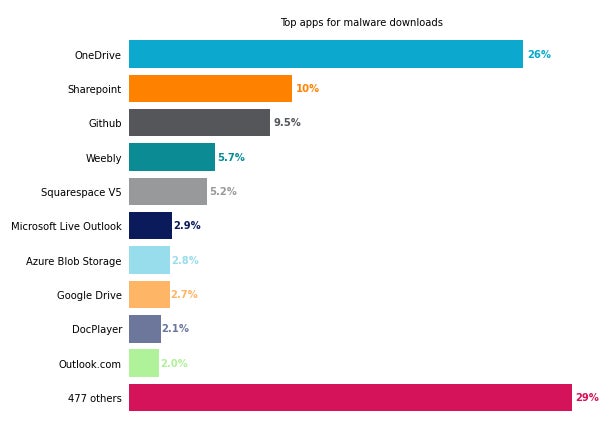
Microsoft OneDrive represents greater than 1 / 4 of the general utilization of cloud storage apps to host malware (26%), forward of SharePoint (10%) and GitHub (9.5%).
Malware communications and information exfiltration
Attackers principally use the HTTP (67%) and HTTPS (52%) protocols for communications between their malicious payloads and their command and management servers; these two protocols are typically totally allowed for customers, as they’re the principle vector for searching the web and will not be filtered by firewalls.
Far behind HTTP and HTTPS, the Area Identify System protocol is utilized in 5.5% of malware communications. The DNS protocol, which is rarely blocked and filtered in organizations, is just not as stealthy as HTTP and HTTPS when transmitting information. Additionally, DNS makes it tougher for attackers to mix with official site visitors from the group and might transmit much less information at a time than HTTP or HTTPS.
Most prevalent risk actors and their motivations
WizardSpider is probably the most prevalent risk actor
Probably the most prevalent risk actor as noticed by Netskope is Wizard Spider, who additionally goes by the aliases of UNC1878, TEMP.MixMaster or Grim Spider. Wizard Spider is answerable for the TrickBot malware, which initially was a banking trojan however advanced to a fancy malware that additionally deployed further third-parties’ malware similar to ransomware.
Concerning potential affiliation, Canzanese informed TechRepublic that “almost each main cybercrime group at present makes use of an affiliate mannequin the place anybody can grow to be an affiliate and use the group’s instruments in opposition to targets of their selecting. Wizard Spider is not any completely different, with associates utilizing their TrickBot malware and a number of ransomware households.”
Risk actors’ major motivations and targets
In keeping with Netskope’s report, most risk actors motivated by monetary acquire originate from Russia and Ukraine; these risk actors have principally unfold ransomware moderately than some other form of malware.
On the geopolitical aspect, Netskope noticed that the largest threats come from China, led by menuPass (often known as APT10, Stone Panda or Purple Apollo) and Aquatic Panda.
Probably the most focused industries fluctuate between financially-motivated actors and geopolitical ones, with monetary companies and healthcare being probably the most focused by geopolitical actors.
Australia and North America are the 2 most-targeted areas for monetary crime as in comparison with geopolitical concentrating on. Once we requested Canzanese why Australia and North America had been focused, he replied, “If requested a distinct means, the reply maybe turns into extra readily obvious: Why is the relative share of geopolitical adversary group exercise increased in the remainder of the world? Such exercise mirrors broader political, financial, navy or social conflicts. So the upper share of geopolitical adversary exercise in the remainder of the world seems to be the results of lively conflicts and the broader geopolitical local weather in these areas.”
Learn how to mitigate these cloud safety threats
Firms ought to take these steps to mitigate such cloud safety threats:
- Deploy electronic mail safety options that may analyze hooked up information and hyperlinks to detect phishing and malware.
- Educate customers on easy methods to detect phishing and social engineering schemes which may put them or the corporate in danger. Specifically, customers shouldn’t obtain any content material from the web, even when saved on cloud apps, that doesn’t originate from a trusted contact.
- Hold all software program and working methods updated and patched with a purpose to keep away from being compromised by a typical vulnerability.
Disclosure: I work for Pattern Micro, however the views expressed on this article are mine.

