


It’s laborious to beat the vitality density of chemical fuels. Batteries are quiet and clear and simple to combine with electrically powered robots, however they’re 20 to 50 instances much less vitality dense than a chemical gasoline like methanol or butane. That is fantastic for many robots that may afford to only carry round a complete bunch of batteries, however as you begin robots which might be insect-size or smaller, batteries merely don’t scale down very properly. And it’s not simply the batteries—electrical actuators don’t scale down properly both, particularly should you’re on the lookout for one thing that may generate lots of energy.
In a paper printed 14 September within the journal Science, researchers from Cornell have tackled the small-scale actuation downside with what is actually a really tiny, very tender internal-combustion engine. Methane vapor and oxygen are injected right into a tender combustion chamber, the place an itty-bitty li’l spark ignites the combination. In half a millisecond, the highest of the chamber balloons upward like a piston, producing forces of 9.5 newtons by means of a cycle that may repeat 100 instances each second. Put two of those actuators collectively (driving two legs a bit) and also you’ve received an exceptionally highly effective tender quadruped robotic.
Every of the 2 actuators powering this robotic weighs simply 325 milligrams and is a couple of quarter of the dimensions of a U.S. penny. A part of the explanation that they are often so small is that many of the related elements are off-board, together with the gasoline itself, the system that mixes and delivers the gasoline, and {the electrical} supply for the spark generator. However even with out all of that stuff, the actuator has a bunch happening that permits it to function constantly at excessive cycle frequencies with out melting.
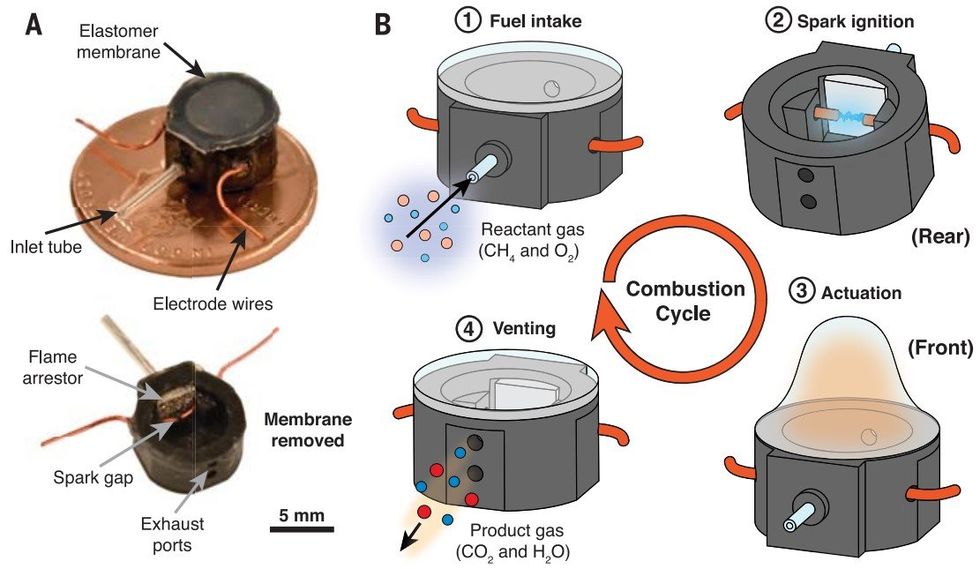 A view of the actuator and its element supplies together with a diagram of the combustion actuation cycle.Science Robotics
The most important challenge could also be that this actuator has to deal with precise explosions, which means that cautious design is required to guarantee that it doesn’t torch itself each time it goes off. The small combustion quantity helps with this, as does the flame-resistant elastomer materials and the built-in flame arrestor. Regardless of the violence inherent to how this actuator works, it’s really very sturdy, and the researchers estimate that it could possibly function constantly for greater than 750,000 cycles (8.5 hours at 50 hertz) with none drop in efficiency.
“What’s attention-grabbing is simply how highly effective small-scale combustion is,” says Robert F. Shepherd, who runs the Natural Robotics Lab at Cornell. We lined a few of Shepherd’s work on combustion-powered robots practically a decade in the past, with this bizarre pink leaping factor at IROS 2014. However going small has each challenges and advantages, Shepherd tells us. “We function within the decrease restrict of what volumes of gases are flamable. It’s an attention-grabbing place for science, and the engineering outcomes are additionally helpful.”
The primary of these engineering outcomes is a bit of insect-scale quadrupedal robotic that makes use of two of those tender combustion actuators to energy a pair of legs every. The robotic is 29 millimeters lengthy and weighs simply 1.6 grams, however it could possibly bounce a staggering 59 centimeters straight up and stroll whereas carrying 22 instances its personal weight. For an insect-scale robotic, Shepherd says, that is “close to insect degree efficiency, leaping extraordinarily excessive, in a short time, and carrying giant masses.”
Cornell College
It’s a bit of bit laborious to see how the quadruped really walks, because the actuators transfer so quick. Every actuator controls one facet of the robotic, with one combustion chamber related to chambers at every foot with elastomer membranes. A bonus of this actuation system is that because the energy supply is fuel stress, you possibly can implement that stress someplace apart from the combustion chamber itself. Firing each actuators collectively strikes the robotic ahead, whereas firing one facet or the opposite can rotate the robotic, offering some directional management.
“It took lots of care, iterations, and intelligence to provide you with this steerable, insect-scale robotic,” Shepherd informed us. “Does it need to have legs? No. It may very well be a speedy slug, or a flapping bee. The amplitudes and frequencies attainable with this method enable for all of those potentialities. In reality, the true challenge now we have is making issues transfer slowly.”
Getting these actuators to decelerate a bit is without doubt one of the issues that the researchers are subsequent. By buying and selling velocity for drive, the thought is to make robots that may stroll in addition to run and bounce. And naturally discovering a option to untether these techniques is a pure subsequent step. A number of the different stuff that they’re interested by is fairly wild, as Shepherd tells us: “One thought we need to discover sooner or later is utilizing aggregates of those small and highly effective actuators as giant, variable recruitment musculature in giant robots. Placing hundreds of those actuators in bundles over a inflexible endoskeleton may enable for dexterous and quick land-based hybrid robots.” Personally, I’m having bother even picturing a robotic like that, however that’s what’s thrilling about it, proper? A big robotic with muscle tissues powered by hundreds of tiny explosions—wow.
Highly effective, tender combustion actuators for insect-scale robots, by Cameron A. Aubin, Ronald H. Heisser, Ofek Peretz, Julia Timko, Jacqueline Lo, E. Farrell Helbling, Sadaf Sobhani, Amir D. Gat, and Robert F. Shepherd from Cornell, is printed in Science.

