


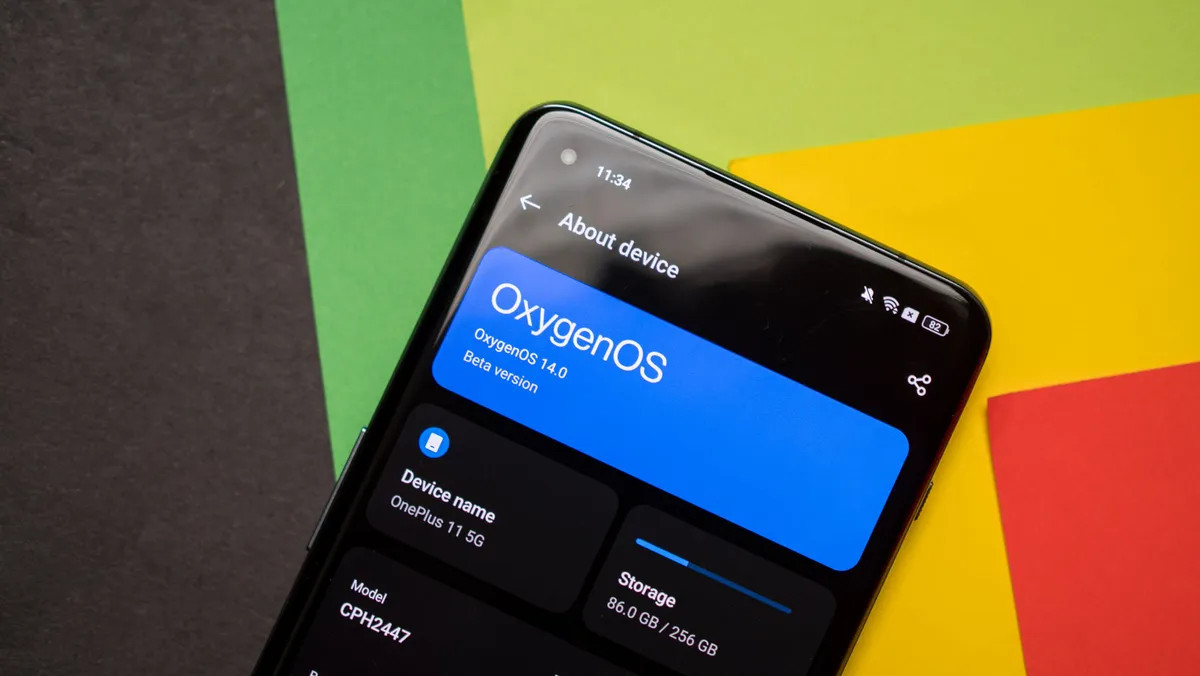
OnePlus is placing the ending touches on OxygenOS 14; the general public beta is now rolling out, and the model is soliciting suggestions from customers around the globe. On the outset, OxygenOS 14 is not too totally different to final yr; the interface options the identical design aesthetic, albeit with a number of delicate adjustments — it makes use of an Aquamorphic 2.0 design language that dynamically adjustments colours based mostly on time of day.
Then there’s the awkwardly-named Fluid Cloud function that primarily tries to imitate the iPhone’s Dynamic Island on the standing bar. While you launch a timer, make a name, or play music, you may see a pill-sized icon within the standing bar, and interacting with it can develop to a full-size window with extra controls.
Forward of the general public beta of OxygenOS 14, I interacted with Gary Chen, OnePlus Product Partnership Lead, and Zach Lin, Lead on OxygenOS Product, to speak about OxygenOS 14 and what the long run holds for OnePlus’s software program efforts. Chen has overseen OnePlus’s software program for a number of years now, and was on the helm in the course of the OxygenOS 11 design overhaul and all through the ColorOS transition.

We obtained began with OxygenOS 14 and the most important user-facing adjustments within the Android 14-based construct. Lin shared some extra particulars round Fluid Cloud, noting that it was impressed by the “strong, liquid, and gasoline construction of Aquamorphic Design,” and {that a} key endeavor with the visible refresh is to offer an “intuitive stream” that is sensible to anybody simply getting began with the interface quite than getting customers to adapt to a brand new function.
“The methods to work together with data and notifications is totally different with Fluid Cloud function. Impressed by the strong, liquid, and gasoline construction of Aquamorphic Design, Fluid Cloud presents notifications inside bubbles, capsules, and panels in a naturally merging and flowing method. This reimagined model of the standing bar can current totally different types of real-time companies with minimal disruption on the prime of your display in response to your personalised preferences and priorities.”

Lin additionally delved into the shifting shade palette and the brand new ringtones and notification tones which might be debuting in OxygenOS 14. “The color system additionally upgraded to have the ability to change dynamically based mostly on elements together with time of the day, smartphone standing, and content material. As an example, the background color of Alarm Clock can be totally different at totally different time all through the day. There are additionally 9 units of Aquamorphic-themed ringtones — together with calls, alarms, and notifications which is co-developed with Sonic Minds from Denmark and Epic Sound from Finland, each of whom are skilled artists with wealthy music-related expertise.”
As for different options, I requested if OnePlus would take into account rolling out a desktop mode — like Samsung DeX — on its telephones. Lin shared a few of the productiveness options debuting in OxygenOS 14, however would not touch upon a desktop mode, so it isn’t on the playing cards as of now. “The File Dock function permits for acquire and share data and content material anytime throughout totally different screens like telephones and tablets by merely dragging and dropping. As well as, on OxygenOS 14, OnePlus gadgets are extra linked than earlier than. Multi-Display screen Join 2.0 permits for quicker connection speeds, in addition to smoother two-way discovery capabilities.”
Stability has been a continuous challenge for OnePlus during the last 18 months, with the ColorOS integration introducing a slew of bugs that severely hampered the consumer expertise. OxygenOS 13 fastened issues to an extent, and Lin famous that “stability, smoothness, and energy effectivity are extremely prioritized within the growth of OxygenOS 14”. One of many causes the beta program is being opened as much as far more gadgets this yr — 16 in complete — is to get suggestions from a wider vary of customers.
One other method the model is wanting to make sure higher stability is by overhauling the underlying framework. The Trinity Engine makes use of six algorithms to raised optimize the {hardware}, and Lin states that the guiding mission with OxygenOS 14 is to ship a “quicker, smoother, extra secure and safe expertise.”
“You will have observed that we spent so much in introducing applied sciences and algorithms on OxygenOS 14. It’s because that the product philosophy of OxygenOS 14 is to make the most of self-developed applied sciences and algorithms to raised discover the potential of the highly effective {hardware} of OnePlus gadgets,” stated Lin. “As an example, our customers will not be conscious of algorithms comparable to CPU-Vitalization, RAM-Vitalization, and ROM-Vitalization, however finally they may get a quicker, smoother, extra secure and safe expertise with higher energy effectivity.”

What made OxygenOS a cult favourite was its clear and clutter-free UI, which was left behind within the transition to ColorOS. So I requested Chen if OnePlus would ever take into account going again to a vanilla UI — sadly, that ship has sailed. “After the mixing, OxygenOS and ColorOS are developed on the identical codebase, to permit for higher construct high quality and updates, which can even result in some similarities.”
“In consequence, OxygenOS will share the identical design philosophy — Aquamorphic Design with ColorOS to include the colourful color system, nevertheless it nonetheless has personalized design parts together with icons, widgets, wallpapers, ringtones, and AOD to satisfy the wants of OxygenOS customers. Our final objective is to synergistically mix the best points of each merchandise, leading to a brand new and distinctive providing,” famous Chen.
I requested if OnePlus may take into account rolling out a function that lets customers select between a vanilla UI and a themed interface — just like what ASUS does with ZenUI — and whereas Lin famous that suggestions from the group drives the producer’s choices, he would not verify if such a function would debut on OxygenOS, so I would not wager on it.
As for what’s coming to OxygenOS sooner or later and the place the software program is headed, Chen reiterated the model’s dedication to delivering a quick and clean expertise, and shared that stability and safety can be a key focus. He talked about how the Trinity Engine is vital to realizing these objectives. “It displays our new interpretations on the quick and clean expertise, to be instinctive and free to regulate, which implies each motion and reflection is pure and clean and all you want is to faucet and revel in. The subsequent step is to convey our signature quick and clean expertise to extra OnePlus gadgets.”
With reference to extra gadgets, OnePlus is on the point of launch its first foldable — the OnePlus Open — in a number of weeks, so I requested Chen if there are any foldable-focused options in OxygenOS 14. He did not share any specifics, solely noting that the model is “working very intently with Google to co-develop foldable-related options.”
“We are attempting to leverage our profitable expertise in growing candy-bar smartphone software program merchandise to shine the consumer expertise on a foldable telephone,” stated Chen.
Like each different producer, OnePlus is wanting so as to add AI-related options to OxygenOS, and though Chen did not expose any particulars, he talked about that OnePlus continues to be on the exploratory stage, and that it is working with companions to see the way it may make the interface higher. “At present, we’re working intently with our partnerships to discover the best way to incorporate AIGC expertise to enhance the usability of OxygenOS 14.”

